Abstract
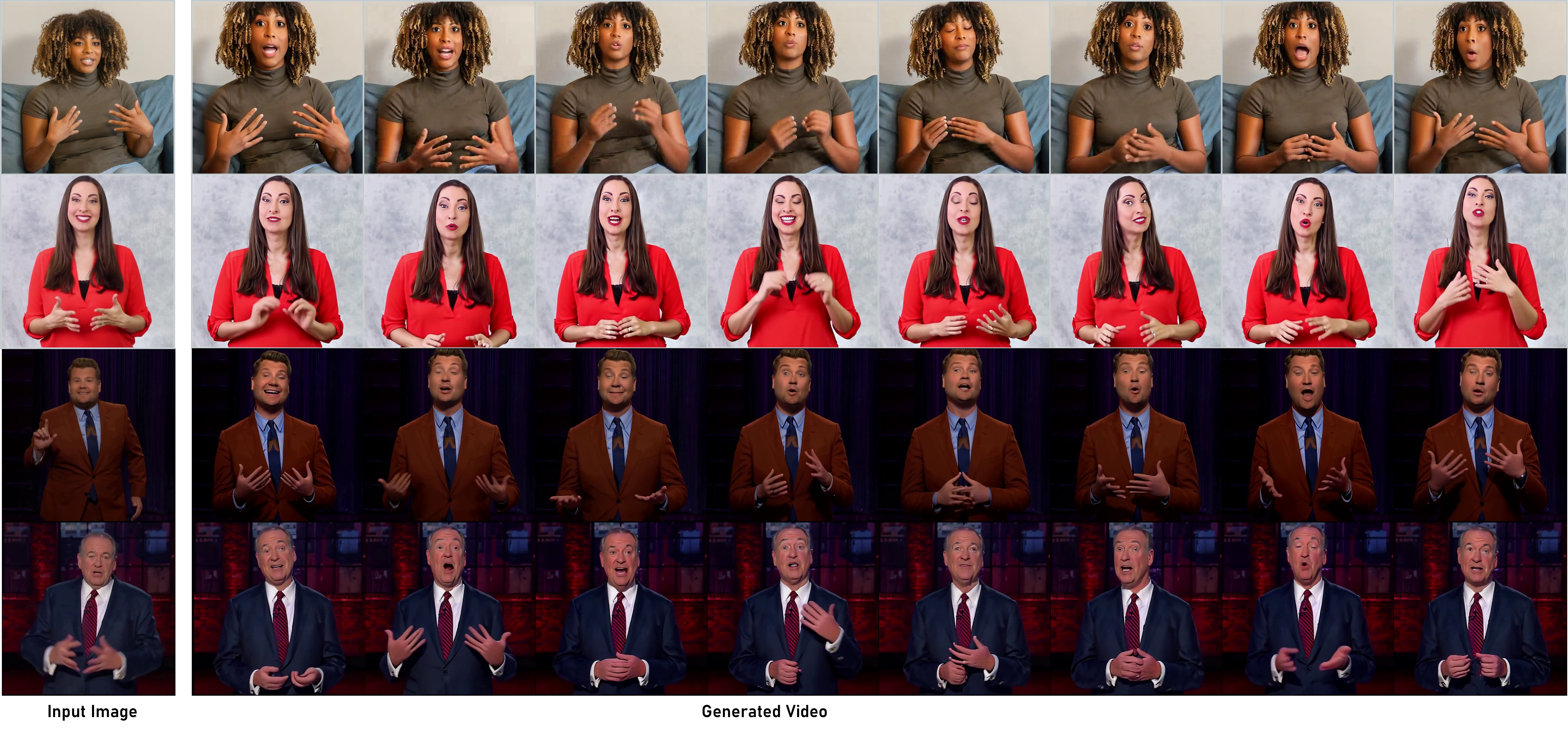
This paper introduces Stereo-Talker, a novel one-shot audio-driven human video synthesis system that generates 3D talking videos with precise lip synchronization, expressive body gestures, temporally consistent photo-realistic quality, and continuous viewpoint control. The process follows a two-stage approach. In the first stage, the system maps audio input to high-fidelity motion sequences, encompassing upper-body gestures and facial expressions. To enrich motion diversity and authenticity, large language model (LLM) priors are integrated with text-aligned semantic audio features, leveraging LLMs' cross-modal generalization power to enhance motion quality. In the second stage, we improve diffusion-based video generation models by incorporating a prior-guided Mixture-of-Experts (MoE) mechanism: a view-guided MoE focuses on view-specific attributes, while a mask-guided MoE enhances region-based rendering stability. Additionally, a mask prediction module is devised to derive human masks from motion data, enhancing the stability and accuracy of masks and enabling mask guiding during inference. We also introduce a comprehensive human video dataset with 2,203 identities, covering diverse body gestures and detailed annotations, facilitating broad generalization. The code, data, and pre-trained models will be released for research purposes.
Method

Results
1. 3D Driven Results
2. Comparison Experiments
Comparison with state-of-the-art methods demonstrating our superior performance in motion quality and audio-visual synchronization.
3. More Results
Citation
Ethics Statement
Our work on single-image and audio-driven human video generation has potential applications in entertainment, education, and assistive technologies. However, we acknowledge the risks of misuse, such as generating deceptive deepfakes, infringing on privacy, or amplifying biases. We advocate for responsible development, encourage transparency in synthetic media, and urge users to adhere to ethical guidelines. By addressing these concerns, we aim to promote beneficial uses of this technology while mitigating its harmful impacts.